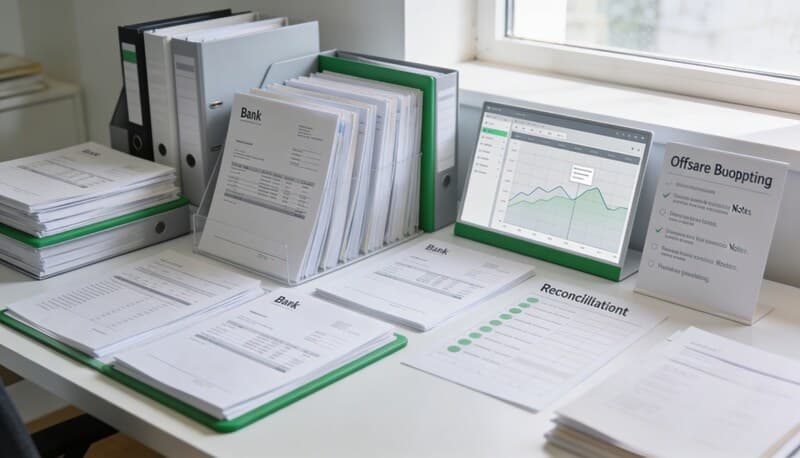
Convert PDF Bank Statements to QIF for Quicken

People searching for convert PDF bank statement to QIF are usually stuck in a very specific workflow.
They have transaction history trapped in PDF statements, and the destination system expects QIF or something close to it.
The temptation is to look for a "direct PDF to QIF converter" and hope the problem is solved in one click.
In reality, the hard part is not the QIF file.
The hard part is getting the transaction rows right before the QIF is created.
Why PDF to QIF is harder than it sounds
QIF is structured.
PDF statements are not.
A QIF workflow expects transaction fields to be stable enough to map cleanly. But PDF statements introduce the usual document problems:
- broken line items
- wrapped descriptions
- ambiguous signs
- repeated balance rows
- OCR noise on scanned pages
If those mistakes make it into the intermediate data, the QIF file can still be technically valid while the accounting result is wrong.
Choose your workflow
PDF bank statement to QIF
Use QIF output for Quicken-style downstream imports.
Bank statement to QIF
Convert statement PDFs into QIF without rebuilding rows by hand.
Bank statement to CSV converter
Start from the general statement-conversion workflow.
PDF to CSV converter
Use the broad PDF-to-CSV workflow for statement and document cleanup.
Bank statement conversion hub
The full cluster for PDF, CSV, OCR, and review-first statement workflows.
Coverage and resources
Open the authority pages that support this workflow.
Supported banks
See which institutions have dedicated coverage pages and where statement fallback still makes sense.
Open page →
Supported statement types
See which source documents Wesley can clean up before export or import prep.
Open page →
Bank Statement Cleanup SOP for Bookkeepers
A bank statement cleanup SOP for bookkeepers who need a repeatable review process before exporting to QuickBooks, Xero, QIF, or spreadsheet workflows.
Open page →
QIF and Quicken Statement Import Prep
Use Wesley when the destination still needs QIF or Quicken-style import files after statement extraction and review.
Open page →
The practical way to approach PDF to QIF conversion
The safest sequence is:
- extract the statement into a clean transaction table
- review the rows for sign, date, and duplicate-balance issues
- normalize the fields you need for the destination
- generate or map the reviewed result into QIF
That may sound less magical than "direct conversion," but it is the workflow that prevents hours of cleanup later.
What to verify before anything becomes QIF
| Field to verify | Why it matters |
|---|---|
| Date | One OCR date mistake shifts the transaction into the wrong period |
| Payee or description | Wrapped text can split one transaction into two records |
| Amount sign | Reversed inflows and outflows are easy to miss in imports |
| Opening and closing balance rows | These should not be treated as normal activity |
| Duplicates | Carry-forward rows often look like real transactions |
If your extraction tool does not help you review those items, it is not solving the risky part of the workflow.
When you may not need QIF at all
This is the part many searchers only realize after they start.
If your destination accepts a cleaner format directly, it may be better to stop before QIF:
- QuickBooks users may prefer QBO CSV or QBD CSV
- Xero users may prefer Xero CSV
- review workflows may only need Generic CSV
That is useful because some teams search for PDF to QIF when what they really want is "get this PDF history into a bookkeeping system without typing it by hand."
Where Wesley fits in a QIF workflow
Wesley does not try to pretend the PDF is already structured accounting data.
It helps with the step that usually consumes the most time:
- turning PDF or scanned statements into reviewable rows
- letting you catch broken descriptions or sign issues
- removing non-transaction noise before export
- giving you a clean transaction table you can map to the final destination
If your system accepts CSV directly, that is often the better endpoint.
Wesley supports exports such as:
- Generic CSV
- QBO CSV
- QBD CSV
- Xero CSV
So if QIF is optional in your stack, you can often skip a fragile extra conversion step.
A realistic workflow for PDF bank statements into QIF
1. Extract the statement into rows
You should be able to review the transactions as a table, not just read OCR text.
2. Clean the rows before mapping
Remove:
- opening balances
- closing balances
- headers and footers
- duplicated carried-forward lines
3. Spot-check the highest-risk transactions
Focus first on:
- refunds
- transfers
- card payments
- large inflows or outflows
4. Convert the reviewed table into QIF only after validation
If the rows are correct, the format conversion becomes much less risky.
If the rows are wrong, QIF only hides the problem deeper in the workflow.
Related guides
If your end goal is QuickBooks rather than QIF, use our QuickBooks import workflow.
If your end goal is Xero, use our Xero import guide.
If you are comparing general conversion options first, start with our free converter comparison.
FAQ
Can I convert a PDF bank statement directly to QIF?
Some tools advertise direct conversion, but the success of that workflow still depends on whether the extracted transaction rows are correct.
Why does the import look wrong even when the QIF file was created successfully?
Because the file format can be valid while the source data is still wrong. Sign issues, duplicates, and balance rows are the usual causes.
What if I am working from scanned statements?
Scanned statements make review even more important. OCR mistakes in dates and amounts are easy to miss if the tool only shows the final output.
Is CSV ever better than QIF?
Yes. If the destination system accepts CSV directly, it is often simpler and easier to review than forcing an extra QIF step.
Final takeaway
The real problem in PDF to QIF workflows is not QIF.
It is the quality of the transaction rows before the format conversion.
If you fix that step first, the rest of the process becomes much easier to trust.
If you want to start with a reviewable transaction workflow, use Wesley's document upload flow.
Ready to use the matching workflow?
PDF bank statement to QIF
Use QIF output for Quicken-style downstream imports.
Related reads
Discover adjacent articles without being sent to near-duplicate topics.